IT to employee ratio for MSPs: benchmarks, tiers, and what actually moves the number
TL;DR
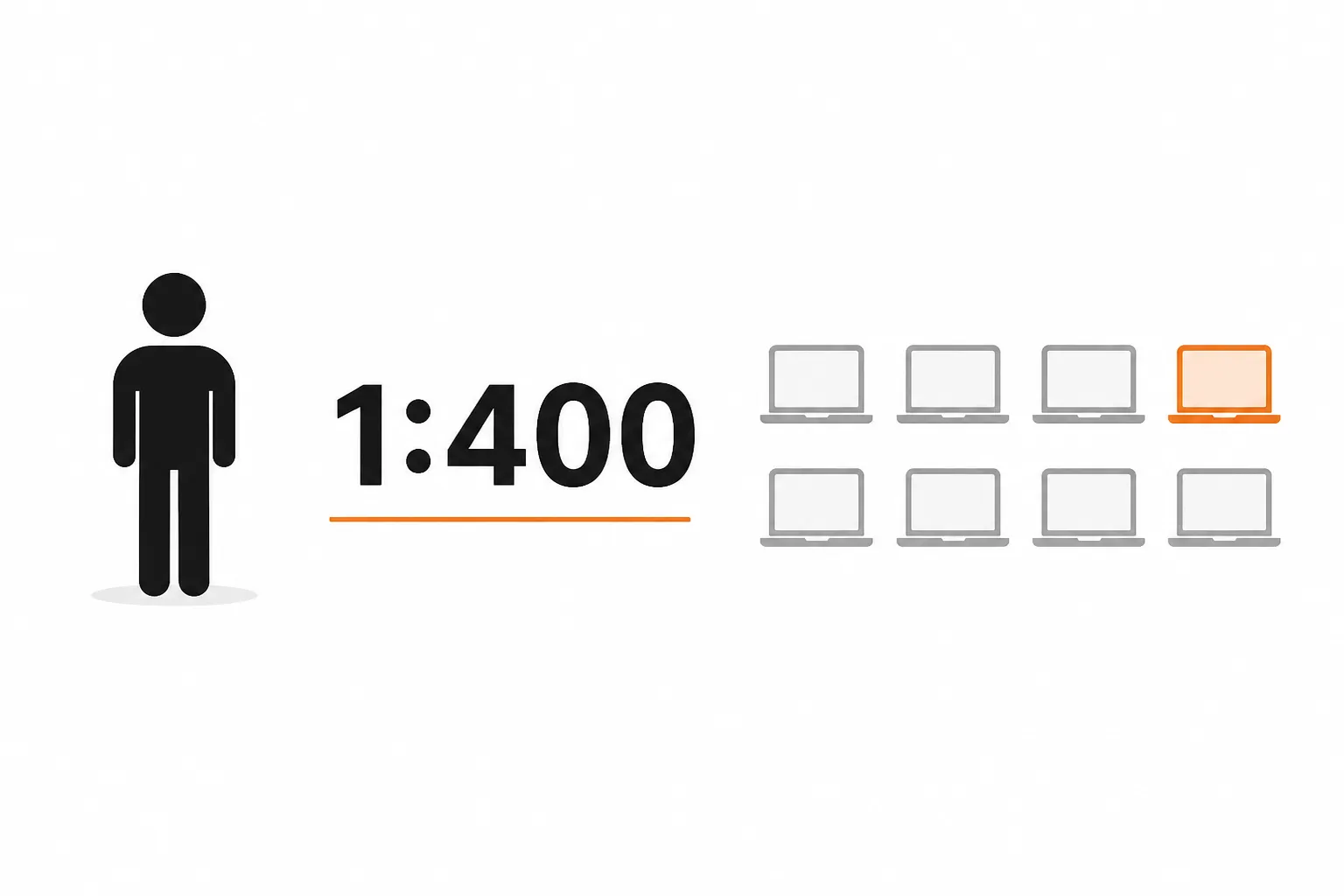
The "right" IT-to-employee ratio doesn't exist as a fixed number - but the benchmarks you actually need do. For MSPs: 350-400 endpoints per technician is the gold standard for a mature, proactive shop. Reactive MSPs run at 150-200. AI-augmented MSPs are pushing past 750. The single biggest lever? Whether your L1 work hits a human or gets resolved autonomously. Tyqra is how MSPs move the ceiling without burning out their team.
Two metrics that get confused constantly
Ask ten MSP owners about their IT-to-employee ratio and you'll get two different units back. That's not sloppiness - it's because the metric actually means two different things depending on who's using it.
IT-to-employee ratio is the traditional measure: how many IT staff support each employee in a company. The Mercer / ITAA baseline puts this at 1:18 for organizations under 500 employees - one IT person for every 18 workers. Averaged across all company sizes, the number sits closer to 1:27. Helpdesk-specific staff can handle 70-100 users each before things start to crack, per Robert Half / Gartner data.
Technician-to-endpoint ratio is what MSPs actually use. Instead of employees, it counts managed devices - laptops, desktops, servers, mobile, IoT. One user might have three endpoints (laptop, desktop, phone), so these ratios run higher. A tech "supporting 400 endpoints" might only have 200 users, but 400 devices to manage. This number maps directly to contracts, capacity, and profitability, which is why it dominates MSP conversations.
For the rest of this post, we're talking about the endpoint ratio - because that's the number that actually tells you whether to hire.
What the benchmarks actually say
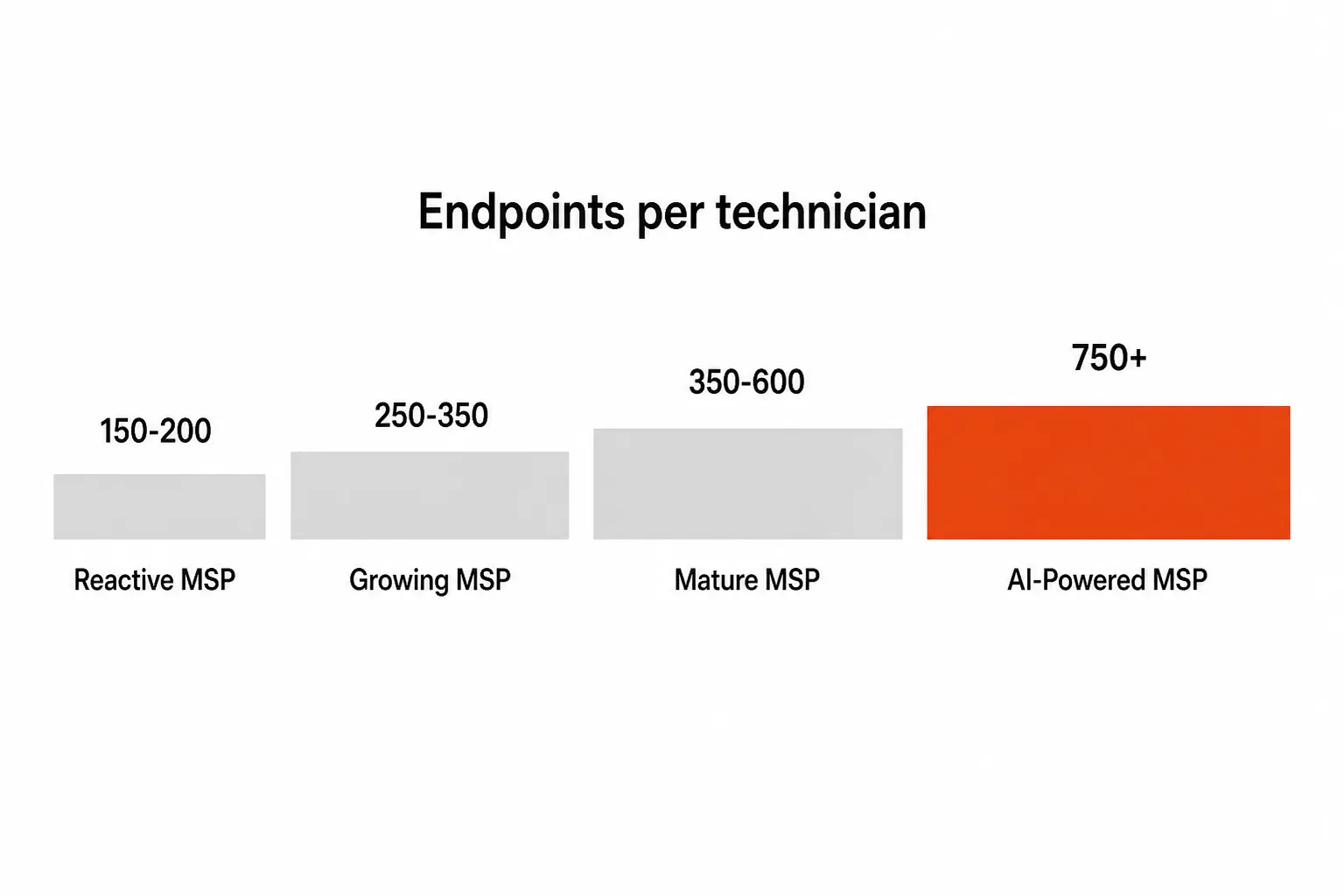
The benchmarks split cleanly by service model:
Reactive MSP (break-fix): 150-200 endpoints per technician. If a client calls in with a problem and your tech has to respond from scratch every time, this is roughly where you land. Limited automation, limited proactive monitoring, high variability in ticket volume.
Mature, proactive MSP: 350-600 endpoints per technician. Acronis pegs the gold standard at 350 for fully managed endpoints - enough to stay personalized and responsive without burning people out. The r/msp community puts the sweet spot at 250-400: below 250 you're probably overstaffed; above 400 you need serious automation or the backlog starts compounding.
AI-augmented MSP: 750+ endpoints per technician. This is where MSPs are landing when AI handles L1 triage and resolution before anything touches a human technician. LinkedIn discussions from MSP operators are putting mature, automation-heavy shops in the 400-600 range with headroom to scale further.
The number isn't a judgment on your team - it's a reflection of your service model.
The tier breakdown most MSPs don't think about
The "endpoints per technician" number gets murkier when you account for the fact that not all technicians do the same work. A tiered structure changes the math significantly:
| Tier | Role | Benchmark endpoints |
|---|---|---|
| L1 | Service desk - triage, basic fixes, first response | 400-500 |
| L2 | Alignment engineer - complex issues, escalations | 750-1,000 |
| L3 | Central / backend infrastructure | 2,000-2,500 |
Source: r/msp consensus thread, November 2024
L1 techs carry the most volume and hit the lowest per-person capacity. L3 infrastructure staff, who aren't fielding tickets at all, can support enormous endpoint counts because they're not the ones picking up the phone. When MSPs talk about "400 endpoints per tech," they're usually talking about L1 - which is also the tier where AI makes the most immediate difference.
What's worth noting: the community consistently argues that who counts as "a technician" in your calculation changes the number dramatically. A 2022 r/msp thread laid out the debate clearly - if you include pre-sales engineers, infrastructure staff, and management in your denominator, your ratio looks healthier than it actually is for the people fielding reactive tickets.
The perception gap nobody talks about
Here's the thing that should alarm every MSP owner: executives and technicians at the same company are looking at wildly different realities.
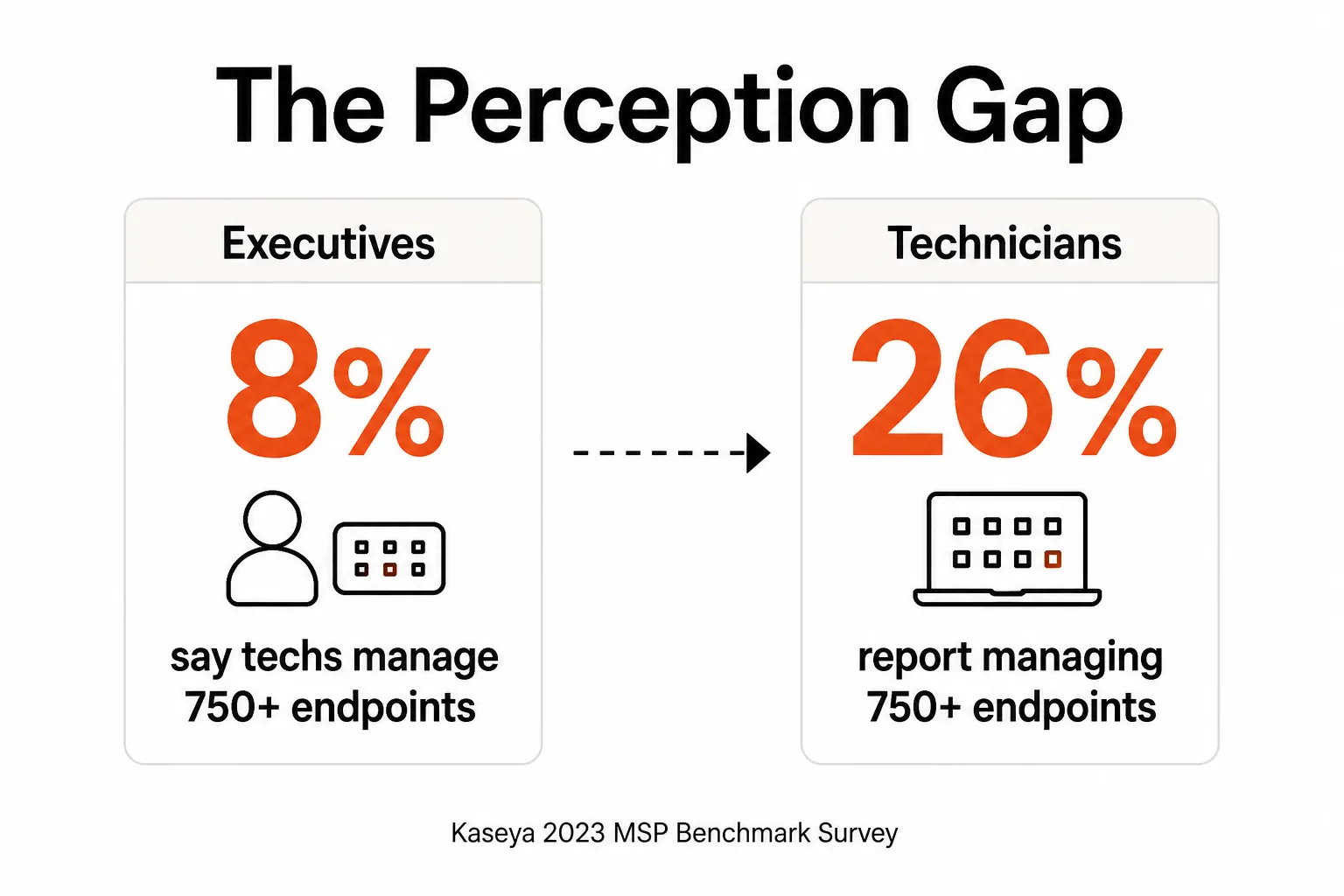
The 2023 Kaseya MSP Benchmark Survey asked 1,091 respondents about technician workloads. The results:
- 8% of executives said their technicians manage 750+ endpoints
- 26% of technicians reported managing 750+ endpoints themselves
That's a 3x gap in perception at the extreme end. The most common range executives cited was 101-250 endpoints per tech. The most common range technicians cited was over 750.
"When asked about the number of endpoints their technicians manage, the most common range among executive respondents was 101 to 250, while technicians reported managing over 750 endpoints as their top range." - Kaseya 2023 MSP Benchmark Survey
This isn't a data discrepancy - it's a management gap. Executives making hiring and automation decisions are working with a fundamentally inaccurate picture of technician workload. If your gut says "we're fine on capacity," your technicians may be quietly drowning.
What actually moves your ratio
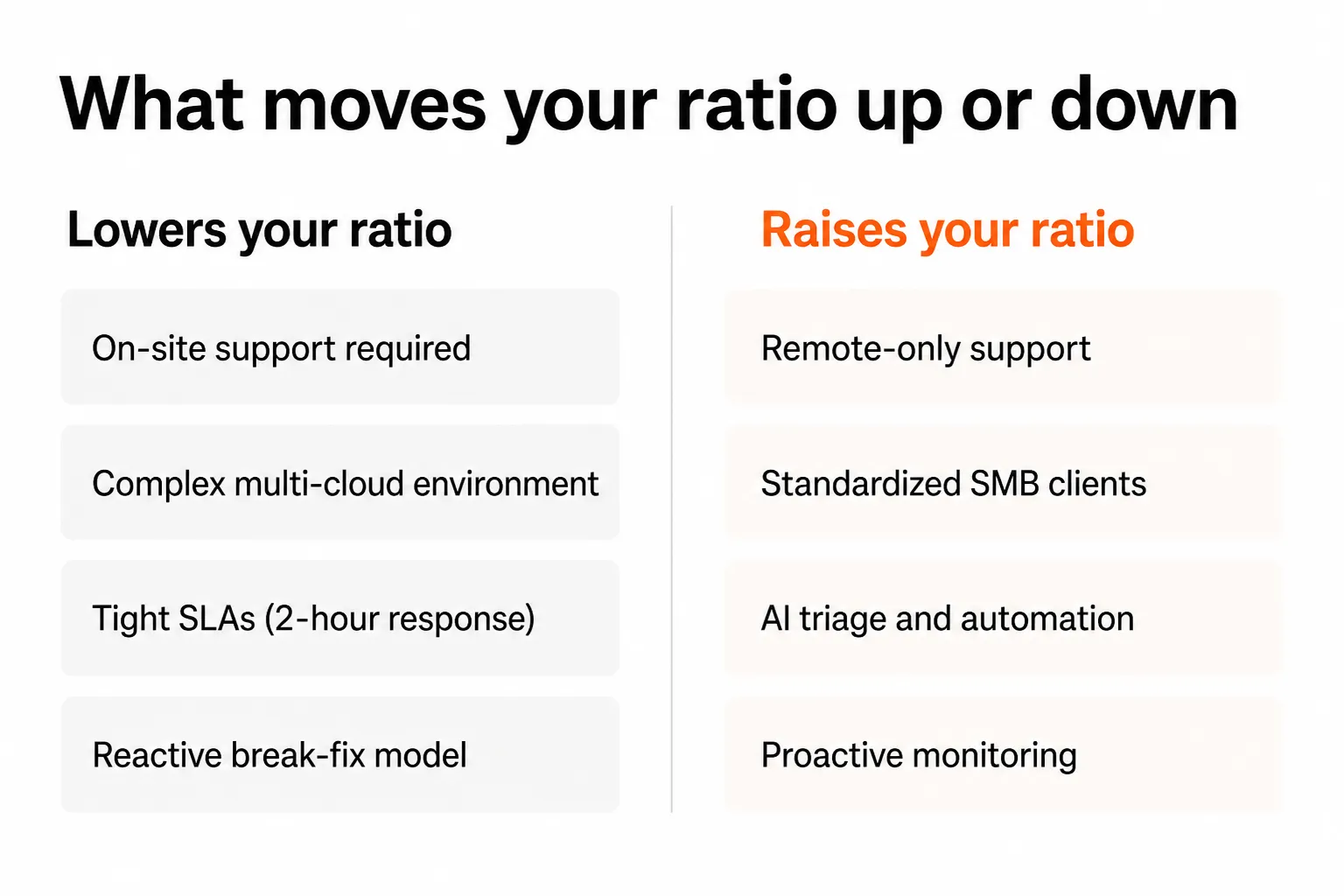
Five factors move the needle more than anything else:
1. Service model. Reactive shops (client calls, you scramble) run at 150-250. Proactive shops with scheduled maintenance, monitoring alerts, and standard runbooks push 350-600. The shift from reactive to proactive is probably the biggest single unlock before automation enters the picture.
2. Remote vs. on-site. A purely remote MSP can support 250-400 endpoints per tech. Add even moderate on-site requirements - physical site visits, hardware work, networking - and that drops to 150-250 because travel eats capacity fast. One MSP on r/msp reported managing only 150 endpoints per tech primarily because of site visit requirements; a comparable remote-only operation would hit double that.
3. Client complexity. SMB clients running Windows, Microsoft 365, and a handful of cloud apps are the high-ratio case - standardized environments mean fewer custom requests, predictable issues, and faster resolution. Enterprise clients with complex multi-cloud stacks, legacy infrastructure, and demanding SLA terms are the low-ratio case.
4. SLA commitments. A 2-hour response SLA requires genuinely available capacity. A 24-hour SLA lets your team queue tickets more efficiently. Selling tight SLAs without the headroom to meet them is where burnout starts.
5. Automation depth. This is the one that's changing fastest. ConnectWise's analysis of AI impact on MSPs is blunt: automation is now "key to survival" rather than a nice-to-have. MSPs with deeply integrated RMM/PSA stacks and automated runbooks support significantly more endpoints per tech than those with siloed tools. Add AI-driven triage on top of that, and the ceiling breaks entirely.
How AI is rewriting the math
The traditional model is linear: more endpoints means more tickets, more tickets means more technicians. That relationship held for decades because the only way to reduce per-technician workload was to hire or automate scripts - and automation scripting required constant maintenance overhead that often ate the gains.
AI is breaking that linearity in a specific way: by absorbing L1 ticket volume before it ever reaches a human. The work AI handles well - password resets, account unlocks, MFA issues, basic onboarding steps, standard diagnostics - is exactly the work that consumes most of the hours in a reactive queue. Guardz's analysis of AI tools for MSPs puts it plainly: the MSPs winning on margins are the ones offloading triage and first-touch resolution to AI, then reserving human technicians for escalations and relationship-critical work.
What's real in 2026: AI agents that deploy in days rather than months, connect to PSA/RMM/identity natively, and resolve tickets end-to-end without workflow builder overhead. Tyqra is the example we'd point to in the MSP space - an AI technician that handles L1 autonomously (password resets, account unlocks, onboarding, offboarding), reaches 96% triage accuracy across category, priority, type, and subtype, and starts working the same week you deploy it. The math on that is real: if your techs spend 40% of their day on L1 work and AI absorbs most of that, your effective capacity per technician improves significantly without a single hire.
The community on r/msp has started talking about this shift directly:
"As a rule of thumb, 400-500 endpoints per service desk tech, 750-1000 endpoints per alignment engineer, and 2000-2500 endpoints per central..." - r/msp, November 2024
Those L1 numbers are already higher than they were five years ago, and they're moving up with automation adoption. The MSPs asking "how many techs do I need for X endpoints?" are asking last decade's question. The better question for 2026 is: how much of our L1 volume can we resolve without touching a human, and what does that do to our endpoint ceiling?
How to know when your ratio is too high
No benchmark saves you from self-awareness. The real signals that your ratio has drifted past sustainable:
- SLA response times creeping up. If you're consistently hitting the edge of your window - or missing it - capacity is the first explanation to check.
- A growing ticket backlog. Overflow accumulating shift-to-shift is a direct readout on capacity shortage.
- Technician burnout and turnover. The Kaseya perception gap data suggests this is more common than executives realize. Turnover is expensive - a departing tech takes client context, institutional knowledge, and capacity with them simultaneously.
- Declining CSAT or NPS. Clients feel overloaded tech teams before you do. Ticket response quality degrades, follow-ups get missed, and the relationship frays.
- Cost per endpoint climbing. If revenue per endpoint is flat but labor cost is rising to sustain service quality, margin is compressing. That's usually the first financial signal that something's structurally wrong.
Two or more of these together isn't a staffing problem - it's a structural capacity problem, and hiring alone rarely fixes structural problems. You also need to reduce what hits your humans in the first place.
Try Tyqra
Tyqra is an AI technician built for MSPs. It connects to your PSA, RMM, and identity stack - ConnectWise, Autotask, Datto, NinjaRMM, Entra ID, Okta, JumpCloud, Google Workspace, IT Glue, Hudu - and handles L1 tickets autonomously: password resets, account unlocks, MFA issues, onboarding, offboarding. No workflow builder, no six-month implementation. It deploys in the same week and starts resolving tickets immediately.
The economics are direct: MSPs typically recover $7K-$15K/month in tech time by offloading 50-100 hours of L1 grunt work per month. At $0.50 per ticket worked, a 500-ticket month costs $250 - less than a single hour of technician time. There's a 14-day free trial with $50 in credit, no card required.
If your technicians are spending hours every day on password resets and account unlocks, that's the ratio problem Tyqra solves directly.
Frequently Asked Questions
What is the standard IT-to-employee ratio for a managed service provider?
There is no single standard - it depends heavily on your service model. Reactive MSPs typically run at 150-200 endpoints per technician. Mature, proactive MSPs with strong automation reach 350-600 endpoints per technician. AI-augmented MSPs are pushing past 750 endpoints per tech by offloading L1 triage and resolution to AI agents like Tyqra.
What is the difference between IT-to-employee ratio and technician-to-endpoint ratio?
IT-to-employee ratio (e.g., 1:27) measures how many IT staff support each employee across the whole company. Technician-to-endpoint ratio (e.g., 400:1) measures how many managed devices - laptops, servers, mobile, IoT - a single technician handles. MSPs use the endpoint ratio far more often because it maps directly to billing, contracts, and capacity planning.
How many endpoints can one MSP technician support?
The Acronis gold standard is 350 fully managed endpoints per technician. The r/msp community consensus for an L1 service desk tech is 400-500 endpoints. L2 engineers typically cover 750-1,000. The ceiling keeps rising as automation tools - including AI technicians like Tyqra - handle more L1 resolution work.
What are the warning signs that my MSP's technician ratio is too high?
Watch for four signals: SLA response times creeping up, a growing ticket backlog, technician burnout or high turnover, and declining CSAT or NPS scores. Any one of these is worth investigating; two or more together usually means you're over-indexed on endpoints relative to available tech capacity. The fix is either adding headcount, automating L1 work, or both.
How does AI change the IT-to-employee ratio for MSPs?
AI agents handle triage, categorization, and basic resolution - the work that used to eat the first 10-20 minutes of every L1 ticket. Tools like Tyqra autonomously resolve password resets, account unlocks, and onboarding tickets without technician involvement. This breaks the linear relationship between endpoint growth and headcount, letting MSPs push their effective endpoint ratios well past 750 per technician without proportionally hiring.